Black’s Profile
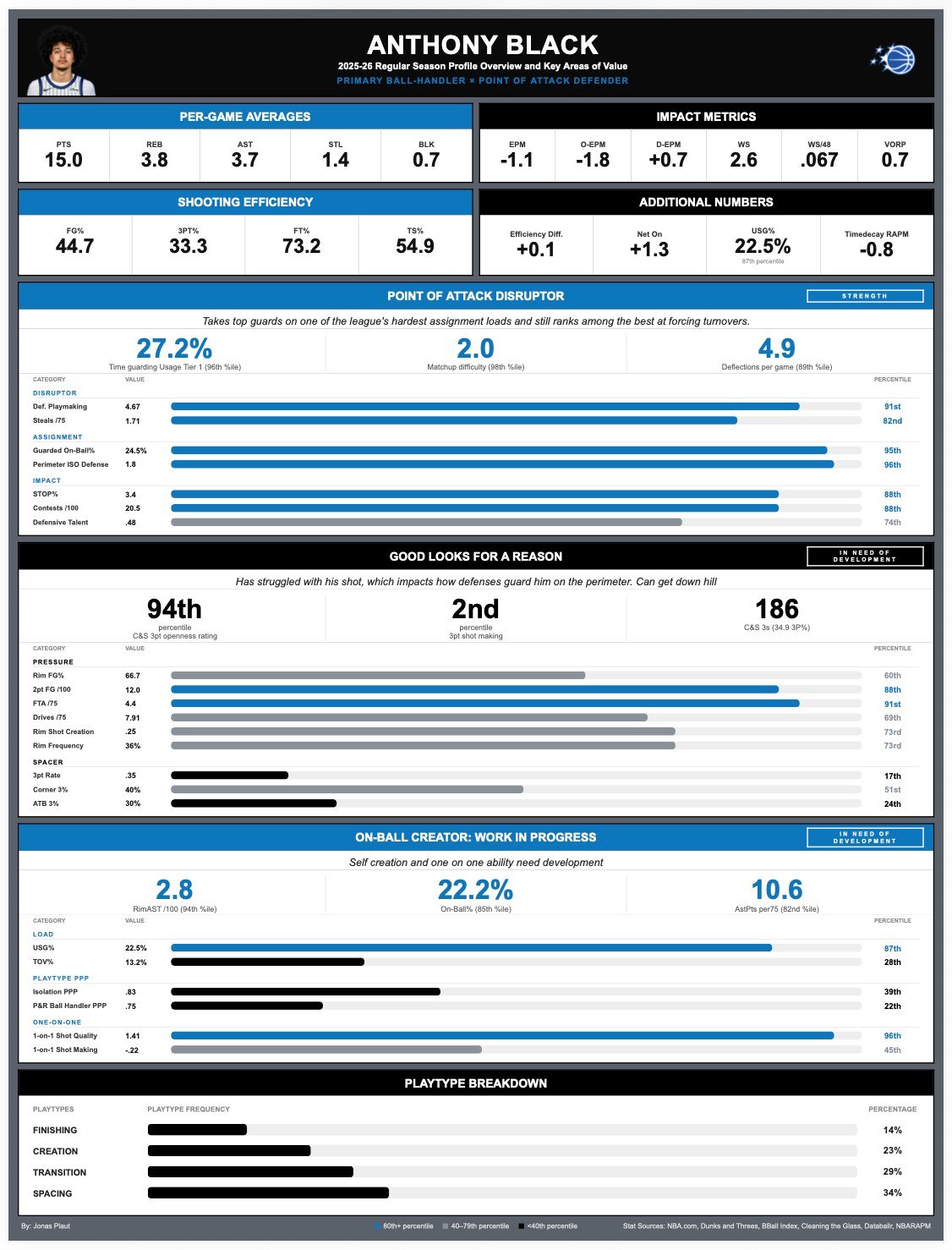
Relevant Questions
The Patience Factor
The 1st overall pick in the 2022 Draft. The 8th overall pick in the 2021 Draft. The 5th overall pick in the 2021 Draft. The 6th overall pick in the 2023 Draft. Four future 1st Round picks in a massive trade. Two rookie-scale Max extensions and a 5-year $150M contract. It is an understatement to say that the Magic has invested heavily in its current core, both through the assets committed to building it and the financial resources now tied to maintaining it. And in return, the roster has not quite lived up to expectations… yet.
“Yet” sits directly at the heart of Orlando’s roster-building. In this context, “yet” implies a degree of hope, an optimism that the team assembled can still come good as currently constructed. In certain ways, “yet” is tied to patience, a belief that the Magic’s Front Office is willing to show as it heads into the 2026-27 season, following an offseason where it worked on the periphery of the roster, leaving the core untouched. However, “yet” does not mean that any one outcome is a certainty, either desirable or undesirable.
Paolo Banchero is only 23 and is entering his 5th season. Franz Wagner is 25 and is entering his 6th season. Suggs is also 25 and entering his 6th. Despite seeming like a grizzled vet, Bane is only 28. Add in Black, who is 22. And while Banchero, Wagner, Suggs, and Black have three years of experience playing together, the grouping (which includes Bane) has only one. Development, team building, and on-court success are rarely linear. Young players do not improve at the same rate, cores do not necessarily develop in a straight line, and progress toward contention can involve both setbacks and steps forward.
Youth and limited time together provide a reasonable explanation for why Orlando has remained patient to date. The Magic has not necessarily reached the point where it can know exactly what this group will become. However, patience does not eliminate the questions facing the organization; it simply gives the team more time to answer them. And that is where the distinction between individual player value and roster value becomes important. It is one thing to believe that Banchero, Wagner, Suggs, Bane, and Black are all valuable players. It is quite another to determine whether those players, collectively, form the foundation of a team capable of competing at the highest level. The questions therefore become: what is the Magic building toward and who is it building around?
Negotiation Dynamics
Orlando needs clarity. Clarity about its core. Clarity about its financial situation. Clarity about its standing within the league landscape.
Thus, a Black negotiation cannot be evaluated in a vacuum and must instead be viewed within the greater organizational context. This is particularly true for Orlando, where the Black negotiation sits at the intersection of nearly every question facing the franchise. The team’s competitive direction remains under a microscope. Even though the Bane trade signaled urgency, the uneven results that followed have introduced uncertainty around what this core ultimately is. Is this a group that can emerge as a true contender with health, continuity and further development, or one that still requires structural recalibration? The answer will meaningfully shape how aggressively Orlando approaches a potential Black extension.
This uncertainty extends to Black’s place within the core itself. If the foundation remains intact, Orlando still needs clarity about how Black fits alongside the players it views as long-term building blocks. Does he amplify the strengths of that group and provide the type of connective value that elevates the ecosystem? Or does his development shift the conversation toward how other pieces fit alongside him? Is Black ultimately a connective starter who enhances the structure around Orlando’s primary players, or a more player-dependent piece whose value is tied to a larger role? These questions will influence not only Black’s individual valuation, but also how the Magic organization thinks about the broader composition of the roster.
The clearest example of this dynamic is the relationship between Black and Suggs. Orlando has already made a significant financial commitment to Suggs, who signed a 5-year $150M extension in 2024 and has 4-years $115.5M remaining on his contract (albeit with a declining Cap %). Black’s development therefore creates an important question for the Magic: can the two form a complementary long-term backcourt within the structure of the roster? They do not need to occupy identical roles, and there is a natural argument that their respective size, defensive versatility and ability to impact the game in different ways can allow them to coexist. But as Black’s role and financial value increase, so too does the importance of determining whether this pairing represents the backcourt foundation Orlando wants to carry forward.
Whether this pairing works likely hinges on one variable: spacing. Can either Suggs’ or Black’s jumper become credible enough that defenses can no longer sag off both guards at once? If not, Orlando risks committing significant money to two defense-first guards occupying the same space on both the court and the Cap Sheet.
The financial layer adds another degree of difficulty. Long-term planning in the 2nd Apron era requires organizations to project multiple seasons ahead. Orlando is already tracking toward Tax and Apron commitments with its existing contracts, while financial outs can only provide limited relief. The team’s primary long-term pieces are all under contract for multiple seasons. Locking in another significant salary slot would therefore reduce future optionality at a time when flexibility carries heightened value, particularly for a team that may still require meaningful roster refinement.
As written about previously, there are two distinct but interrelated windows at play: an on-court window and a financial one. The on-court window is inherently uncertain and probabilistic, shaped by health and variance in player development in ways no Front Office can fully control. This is a context the Magic has experienced firsthand. The financial window, by contrast, is rigid and rule-based, tied directly to the decisions an organization chooses to make. Navigating the overlap between these two timelines is essential, and Orlando still appears to be searching for that balance. When a team sits close to the Tax and/or Aprons and is forced to deal with injuries, underperformance, or variance in play, the mechanisms available to react become increasingly limited. The Magic therefore must evaluate Black not only on what he is worth today, but on whether his next contract fits the team’s broader competitive and financial timeline.
Ultimately, this is not simply about what Black is worth in isolation. It is about what he is worth relative to Orlando’s broader Cap Sheet, its competitive timeline, its roster-building strategy, and its conviction in the current core configuration. These variables complicate what might otherwise seem like a straightforward decision to invest in a 22-year-old starter with a two-way archetype. In that sense, the Black negotiation once again becomes a microcosm of the Magic’s broader inflection point: Orlando is not simply deciding whether to retain a player, but how much it believes in the team structure it has spent years building.
And as with all rookie-extension negotiations, there is also a potential RFA dynamic that adds another layer of uncertainty to the negotiation. For Black, the question is whether a meaningful market will exist for him if he reaches RFA, and whether waiting provides enough potential upside to justify foregoing the certainty of an extension. For Orlando, allowing Black to reach the market would provide additional information and potentially greater negotiating leverage; however, that leverage comes with its own risk. If Black takes another step forward in 2026–27, the price in relation to what Orlando could have secured him at today may rise considerably, while his development could simultaneously generate greater interest around the league. The result is a more delicate balance than a typical rookie-scale extension: both sides have an incentive to weigh the certainty of a deal today against the possibility that the market (and Black’s value) looks materially different a year from now.
Black’s side will be conducting a similar calculation. From his perspective, the question is not simply whether Orlando represents the right long-term environment, but whether the Magic’s uncertainty creates an opportunity to establish a larger role and greater market value before committing. An extension would provide financial certainty and lock in a meaningful payday; however, waiting could allow Black to test whether his development supports a materially higher valuation. The further Black believes his role can expand beyond a connective starting piece, the greater the incentive to bet upon his own development rather than accept Orlando’s valuation today.